GoClaw Features: Lean AI Agent Solution Using Golang

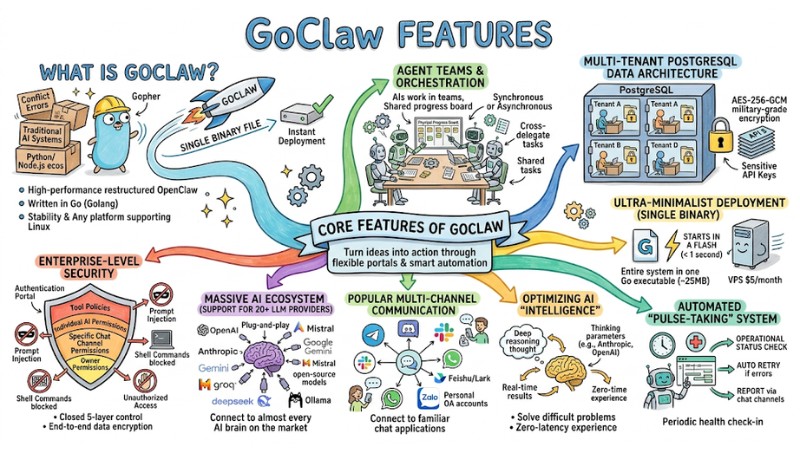
When building an AI Agent for personal or business use, you don't just need features; you need a lean, fast system that is easy to operate long-term—that is why GoClaw, with its Golang architecture and single binary, has become a noteworthy choice. In this article, I will focus on GoClaw's most prominent features: from multi-channel integration, browser automation, and smart home connectivity to security, monitoring, and optimizing AI Agent operational costs.
Key Takeaways
- Breakthrough Single Binary Architecture: Understand how GoClaw completely eliminates the bulkiness of Python/Node.js environments, enabling instant, stable AI Agent deployment with superior resource savings.
- Powerful Core Features: Grasp the capabilities for team-based Agent coordination, secure multi-tenant data management, and a connection ecosystem for over 20+ LLM providers.
- Enterprise-Grade Security: Gain absolute peace of mind with a 5-layer defense barrier, Bubblewrap isolation technology, and AES-256-GCM encryption for all sensitive data.
- Versatile Communication and Integration: Easily control AI via popular chat platforms (Telegram, Zalo, WhatsApp...) and deep integration with smart home devices.
- Optimizing Operational Efficiency: Master AI costs through real-time token monitoring and leverage high-performance gRPC architecture for the fastest response times.
- FAQ: Quick answers to inquiries regarding feasibility, safety, and why GoClaw is the professional choice for real-world environments.
What is GoClaw?
GoClaw is a high-performance restructured version of OpenClaw, written entirely in the Go language (Golang). Unlike traditional AI Agent systems that rely heavily on the Python or Node.js ecosystems, GoClaw is packaged as a single binary file. This completely eliminates library conflict errors, ensuring stability and instant deployment capabilities on any platform supporting Linux.
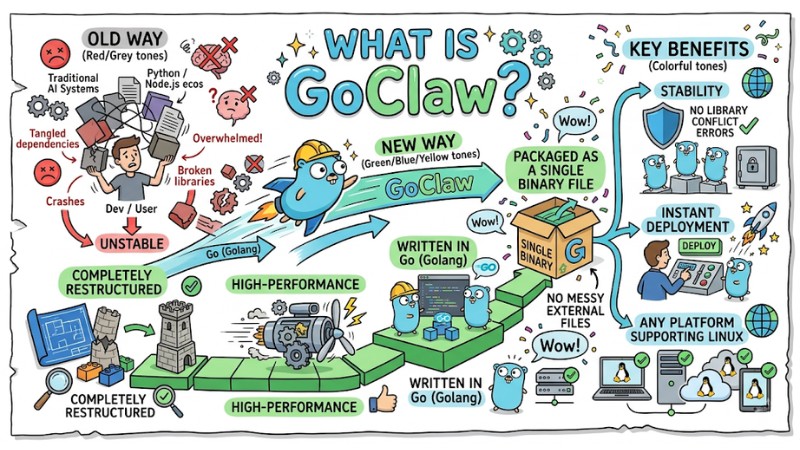
GoClaw is a high-performance refactored version of OpenClaw
Why is GoClaw's Single Binary Architecture Superior?
GoClaw's Single Binary mechanism completely changes how you operate AI. Instead of spending hours setting up virtual environments and managing complex dependencies, you only need a single executable file.
| Feature | Traditional Framework | GoClaw |
|---|---|---|
| Installation | Complex (npm/pip, virtualenv) | Instant (./goclaw) |
| Resources | Large RAM footprint | Optimized (4-8x more savings) |
| Stability | Error-prone due to library conflicts | Perfect (self-contained) |
Technical Analysis: With traditional projects, you frequently face "Dependency Hell" - where the version of one library conflicts with another. GoClaw completely removes this risk by compiling everything into a unified block. The result is near-instant startup times and extremely low resource consumption, allowing agents to operate durably on servers with limited configurations.
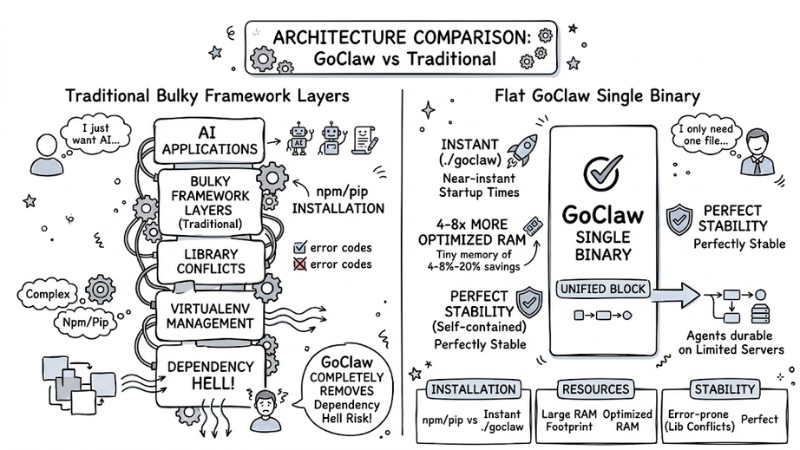
GoClaw stands out with its Single Binary architecture
Core Features of GoClaw
GoClaw turns your ideas into action through flexible connection portals and smart automation:
- Agent Teams & Orchestration: The system does not just have AIs acting individually; it allows them to work in teams with a shared progress management board. AIs can automatically recognize each other's capabilities and cross-delegate tasks (synchronous processing or asynchronous background execution).
- Multi-Tenant PostgreSQL Data Architecture: GoClaw is designed to serve multiple users on the same system securely. Each user has a separate workspace and context files. Session data is completely isolated, and sensitive API keys are encrypted using military-grade standards (AES-256-GCM).
- Ultra-Minimalist Deployment (Single Binary): The entire system is packaged into a single Go executable weighing approximately 25MB. Consequently, it starts in a flash (under 1 second) and can run extremely smoothly on a super-cheap virtual private server (VPS) for just $5/month.
- Enterprise-Level Security: GoClaw protects the system with a closed 5-layer permission control mechanism (from the external authentication portal -> tool policies -> individual AI permissions -> specific chat channel permissions -> owner permissions). Accompanying this is a defense barrier against dangerous cyberattacks such as: Prompt Injection, SSRF, blocking unauthorized shell commands, rate limiting, and end-to-end data encryption.
- Massive AI Ecosystem (Support for 20+ LLM Providers): Provides absolute flexibility by connecting to almost every AI brain on the market: from giants like OpenAI, Anthropic, Google Gemini, and Mistral; performance-optimized platforms like Groq and DeepSeek; to open-source models running locally via Ollama.
- Popular Multi-Channel Communication: No need to build a new interface; the system connects directly to users' most familiar chat applications, including: Telegram, Discord, Slack, WhatsApp, Feishu/Lark, and specifically supports Zalo (both personal accounts and Zalo OA).
- Optimizing AI "Intelligence": The system fully leverages specific deep reasoning/thinking parameters of each provider (such as Anthropic or OpenAI) to solve difficult problems with results returned directly in real-time, providing a zero-latency experience.
- Automated "Pulse-Taking" System: AIs are managed by a periodic health check-in mechanism. According to set schedules, the system automatically checks the AI's operational status, automatically retries if errors occur, and reports via chat channels.
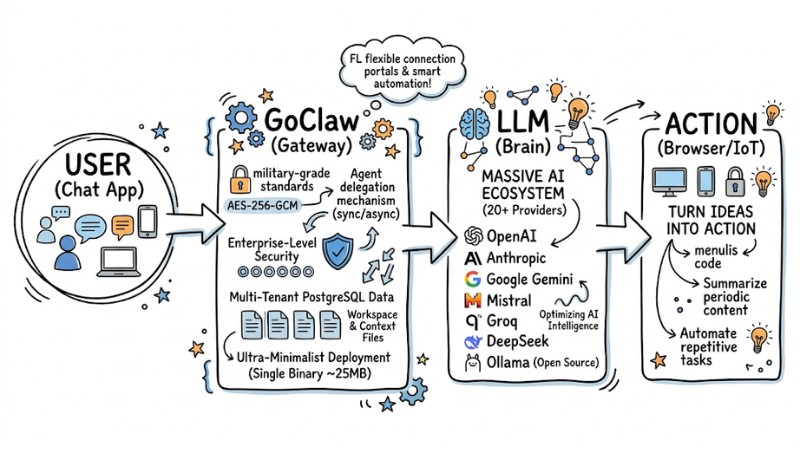
GoClaw's processing procedure
Feature Comparison: OpenClaw vs. ZeroClaw, PicoClaw, and GoClaw
Below is a comparison table of GoClaw's superior features compared to OpenClaw, ZeroClaw and PicoClaw:
| Feature | GoClaw | OpenClaw | ZeroClaw | PicoClaw |
|---|---|---|---|---|
| Multi-tenant Architecture (PostgreSQL) | ✅ | — | — | — |
| MCP Integration | ✅ (stdio/SSE/streamable-http) | — (uses ACP) | — | — |
| Agent teams | ✅ Task board + mailbox | — | — | — |
| Security hardening | ✅ 5-layer defense | ✅ (SSRF, path traversal, injection) | ✅ (sandbox, rate limit, injection, pairing) | Basic (workspace restrict, exec deny) |
| Observability (OTel) | ✅ OTLP (opt-in build tag) | ✅ (opt-in extension) | ✅ (Prometheus + OTLP) | — |
| Prompt caching | ✅ Anthropic + OpenAI-compat | — | — | — |
| Knowledge graph | ✅ LLM extraction + traversal | — | — | — |
| Skill System | ✅ BM25 + pgvector hybrid | ✅ Embeddings/semantic | ✅ SKILL.md + TOML | ✅ Basic |
| Lane-based Scheduling | ✅ (main/subagent/team/cron) | ✅ | Limited concurrency | — |
| Messaging channels | 7+ | 37+ | 15+ | 10+ |
| Companion apps | Web dashboard + Desktop app | macOS, iOS, Android | Python SDK | — |
| Live Canvas / Voice | TTS (4 providers) | ✅ (A2UI + TTS/STT) | — | Voice transcription |
| LLM providers | 20+ | 10+ | 8 native + 29 compat | 13+ |
| Workspace per User | ✅ (PostgreSQL) | ✅ (file-based) | — | — |
| Secrets Encryption | ✅ AES-256-GCM in DB | — (env vars only) | ✅ ChaCha20-Poly1305 | — (plaintext JSON) |
Understanding GoClaw's Security and Data Control
GoClaw applies a "Paranoid by Default" philosophy to protect your workspace. Specifically:
- Isolation with Bubblewrap: GoClaw uses Bubblewrap (Linux standard sandboxing technology) to completely isolate execution processes. The Agent can only access what you permit, preventing system breaches.
- Session Supervision: You always stay in control. The real-time monitoring feature allows you to observe, direct, or directly intervene when an agent is performing automated tasks on the browser.
Operational Efficiency and Cost Management with GoClaw
GoClaw helps you master your finances in AI operations through a real-time token (LLM processing unit) monitoring mechanism.
- Per-turn cost tracking: Costs are calculated immediately after each response, helping you control your AI operational budget without worrying about costs spiraling out of control.
- gRPC Optimization: Utilizing a high-performance transmission protocol (gRPC) results in faster response times and reduced latency, especially when combined with xAI's Grok models.
// Example: Automated budget limit configuration
config := AgentConfig{
    MaxTokensPerTurn: 4096,
    CostAlertLimit:   5.00, // Alert when threshold exceeds $5
    SandboxEnabled:   true,
}
FAQ
Do I need to know how to program to use GoClaw?
No. GoClaw aims for simplicity; you can deploy and use it immediately without implementation into code.
Can GoClaw run on a low-spec VPS?
Yes. Thanks to being written in Go and resource optimization, it runs smoothly on most servers with a Linux kernel, including cheap VPS plans.
Is my data shared externally?
Absolutely not. All data resides in an isolated environment, encrypted with TLS 1.3 and AES-256, ensuring absolute privacy for users.
Can I use multiple accounts at the same time?
Yes. GoClaw supports multi-user with distinct Roles, allowing for flexible administrative and usage permissioning.
Why choose GoClaw over other frameworks?
GoClaw eliminates the bulk of Python/Node.js, providing higher performance, better security, and faster deployment in just minutes.
Why is GoClaw's Single Binary architecture highly regarded?
The Single Binary architecture allows GoClaw to package all functionality into a single executable file. This completely eliminates "dependency hell" and complex installation steps, enabling users to run GoClaw immediately on most Linux operating systems.
Which communication channels does GoClaw support for AI Agents?
GoClaw provides flexible multi-channel support, including Telegram, WhatsApp, and an HTTP UI interface, along with a command-line interface (TUI). This allows users to interact with and control their AI Agents through their most familiar platforms.
How does GoClaw ensure data safety and privacy?
GoClaw uses Bubblewrap technology to create isolated sandbox environments for processes. The "Session Supervision" feature allows users to monitor and intervene in AI Agent activities in real-time, ensuring control and data safety.
Does GoClaw feature text-to-image and video processing?
Yes, GoClaw integrates text-to-image and video generation capabilities through models like Grok. It supports image generation up to 2K and HD video, as well as video editing functions.
Can I integrate GoClaw with smart home devices?
Certainly, GoClaw has built-in integration with Home Assistant. You can control lights, query sensors, and register events from your IoT devices directly through GoClaw.
Read more:
- GoClaw Security: A Secure AI Gateway Solution for Enterprises
- GoClaw Architecture: High-Performance AI Agent Gateway for Production
- GoClaw Use Case: A High-Performance, Ultra-Lean AI Agent Framework
If you are looking for an optimized, powerful, and secure "toolkit" to operate AI Agents without the headache of system maintenance, GoClaw is the professional choice for you. Download GoClaw now to start building high-performance AI Agents from today.