Building Multi-tenant AI Agents: A Roadmap for SaaS Businesses

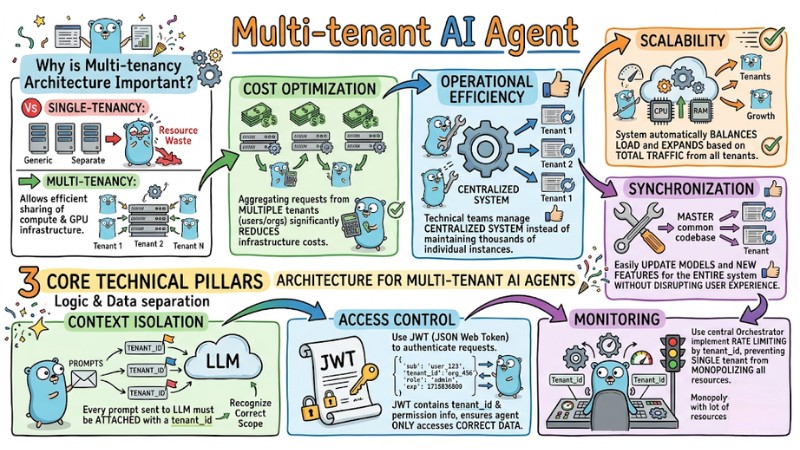
Building a multi-tenant AI Agent system is a crucial step for SaaS businesses to optimize operational costs and enhance scalability. In this article, we provide a technical roadmap to help technical teams deploy Multi-tenant AI Agents effectively, securely, and flexibly.
Key Takeaways
- Importance of Multi-tenancy: Understand how Multi-tenant architecture helps SaaS businesses optimize operational costs, centralize management, and easily scale.
- Comparison of Deployment Models: Clearly distinguish between Dedicated Agents (hard isolation) and Agent-as-a-Service (optimized resource sharing) to make a choice that fits your budget.
- 3 Core Technical Pillars: Master context isolation methods, access control using JWT, and a central Orchestrator to manage thousands of tenants.
- Security and Data: Learn how to protect customer information through data partitioning, throttling, and audit logging in a shared environment.
- Balancing Shared and Personalized: Know how to combine Universal service capabilities with Context-aware personalized experiences to create a competitive product.
- Decision-making Roadmap (Checklist & FAQ): Use specific criteria and answers to common questions to confidently select, deploy, and charge for your AI Agent model.
Why is Multi-tenancy Architecture Important for AI Agents?
In a SaaS environment, allocating a separate AI instance for each customer (single-tenancy) can lead to significant resource waste. In contrast, multi-tenancy architecture allows for more efficient sharing of compute and GPU infrastructure. Specifically:
- Cost Optimization: Aggregating requests from multiple tenants (users/organizations) significantly reduces infrastructure costs.
- Operational Efficiency: Technical teams manage a centralized system instead of maintaining thousands of individual instances.
- Scalability: The system automatically balances load and expands based on the total traffic from all tenants.
- Synchronization: Easily update models and new features for the entire system without disrupting the user experience.
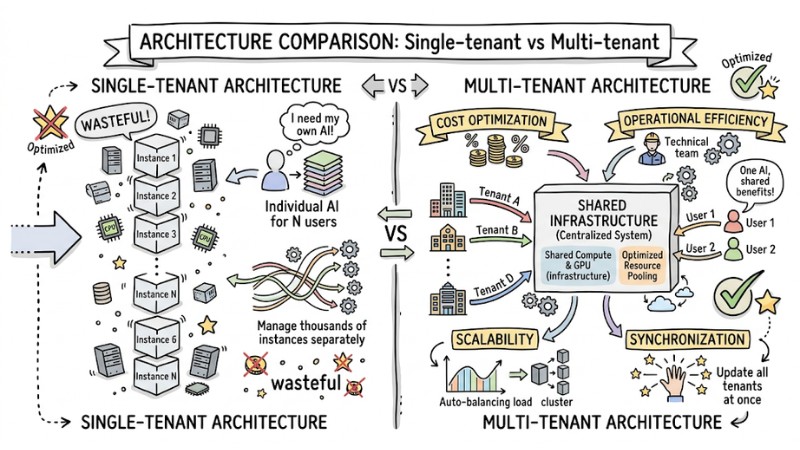
Comparing Single-tenant architecture and Multi-tenant architecture
Comparing 2 Popular AI Agent Deployment Models
The choice of model depends on the budget and the complexity of the business problem. Below is a comparison table of 2 popular AI Agent deployment models:
| Feature | Dedicated Agent (Single-tenant) | Agent-as-a-Service (Multi-tenant) |
|---|---|---|
| Isolation | Physical/Hard | Logical (Software Logic) |
| Cost | Very high | Optimized, shared resources |
| Management | Complex, hard to maintain | Centralized, highly automated |
| Scalability | Slow | Fast, flexible |
3 Core Technical Pillars Architecture for Multi-tenant AI Agents
To operate an agent serving multiple customers, you must ensure absolute separation of logic and data:
- Context Isolation: Every prompt sent to the. LLM must be attached with a
tenant_idto force the model to recognize the correct scope of information. - Access Control: Use JWT (JSON Web Token) to authenticate requests. The JWT contains
tenant_idand permission information, ensuring the agent only accesses the correct data for that customer.
{
  "sub": "user_123",
  "tenant_id": "org_456",
  "role": "admin",
  "exp": 1715836800
}
- Monitoring: Use a central Orchestrator to implement rate limiting by
tenant_id, preventing a single tenant from monopolizing all resources.
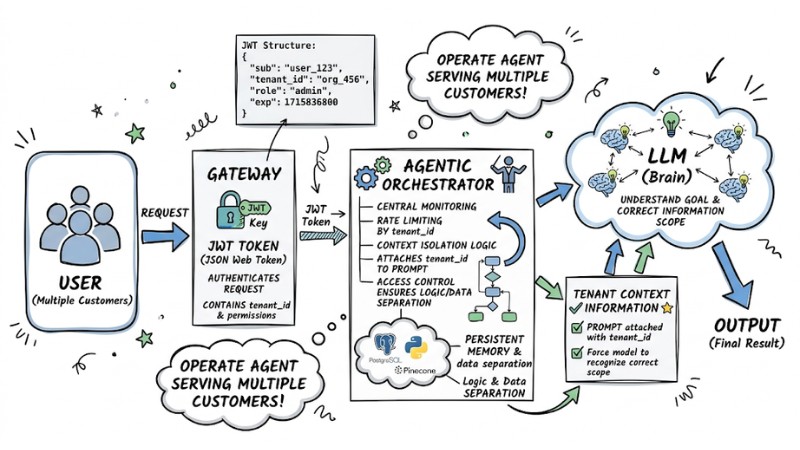
Authentication flow from User to LLM with Tenant Context information
Handling Security and Data Challenges in a Shared Environment
Security is a survival factor when data from many customers resides on the same system.
- Data Isolation: For Vector Databases (where agent knowledge is stored), use Namespace or Partitioning mechanisms to split data by each
tenant_id. This prevents information leakage between organizations. - Dynamic Throttling: Apply dynamic traffic limiting mechanisms to handle the Noisy Neighbor problem (one customer sending too many requests causing system congestion).
- Audit Logging: Trace every agent action along with tenant identification information to support security auditing.
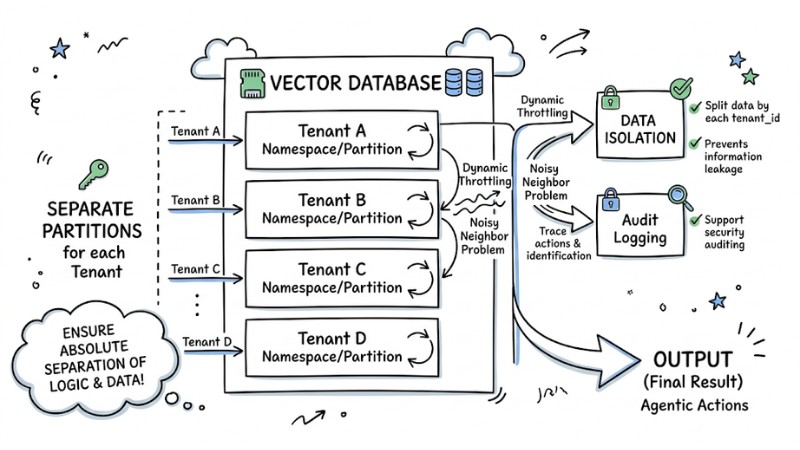
Vector Database with separate Partitions for each Tenant, ensuring data is not mixed
Core Factors When Designing Agent-as-a-Service
When designing Agent-as-a-Service for a multi-tenant environment, you need to balance shared infrastructure with personalized experiences for each customer. Some core factors include:
- Universal Experience: Configure agents to serve general purposes for all tenants using shared resources.
- Context-aware Experience: Personalize agent behavior based on the specific data, preferences, and configurations of each tenant.
- Distributed Identity: Every component in the system must be able to authenticate each other through hierarchical identification to ensure consistency.
Checklist for Selecting a Suitable Deployment Model
Once you understand the pros and cons of each model, you can use the checklist below to choose the deployment architecture that fits your context and requirements:
- Choose Dedicated when: Security requirements are extremely high, needing strict compliance with data regulations (such as finance or healthcare).
- Choose AaaS when: Needing to optimize operational costs, prioritizing deployment speed and the ability to scale rapidly.
Re-evaluation: Check if the infrastructure budget and the team's management capacity match the intended model.
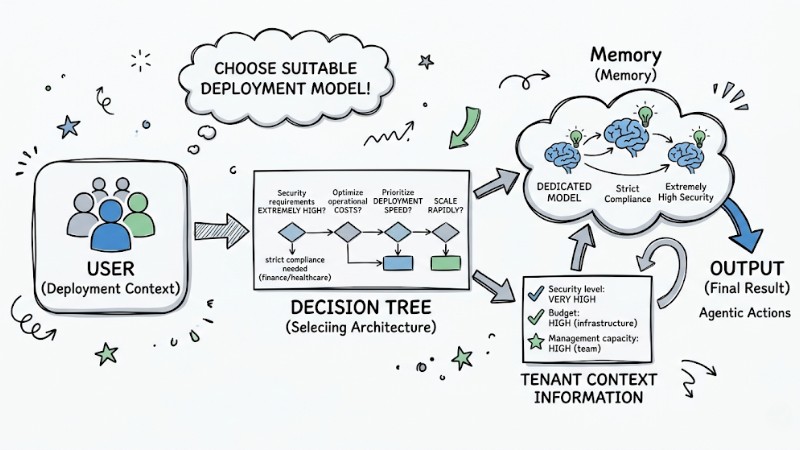
Decision tree for selecting architecture based on: Security level - Budget - Management capacity
FAQ
How to manage Memory for thousands of tenants?
You should use distributed storage mechanisms (such as Redis with keys containing tenant_id) to manage separate conversation contexts for each user, ensuring the agent always "remembers" the correct information of the customer currently interacting.
How to ensure the Agent does not "confuse" between customers?
By injecting tenant_id into the system prompt and using metadata filters in Vector Database queries, you create a "logical wall" preventing the agent from accessing knowledge outside the scope of that tenant.
Is a separate Agent needed for each tenant?
No. In the AaaS model, you use a common Agent Engine but provide different tools and data through context injection. This is much more efficient than creating thousands of Agent instances.
How to charge customers based on Agent usage?
You should track the number of. tokens consumed, session counts, or specific tasks for each tenant_id through a log management system to establish appropriate pricing tiers.
What is a Multi-tenant AI Agent?
A Multi-tenant AI Agent is an AI system designed to serve multiple customers (tenants) on the same infrastructure, optimizing costs and resources.
Why is Multi-tenancy important for AI Agents?
Multi-tenancy helps reduce operational costs, increase resource utilization efficiency, and allows for more flexible system scaling to meet the needs of many customers.
Comparing the difference between Dedicated Agent and Agent as a Service (AaaS)?
Dedicated Agent means each customer has their own agent, expensive but highly isolated. AaaS shares one agent for many customers, saving costs but requiring logical isolation management.
How to ensure Data Isolation in AaaS?
Use Namespaces or Partitioning in the Vector Database, attaching tenant_id to data and requests to distinguish and isolate each tenant's information.
Should I use Universal or Context-aware AI Agents?
There is no "one right type for all cases" answer; typically you will combine both and prioritize each based on the stage.
- Universal Agents are suitable when you want to launch quickly, standardize basic experiences, and optimize costs, as all customers share the same set of capabilities and flows.
- Context-aware Agents are suitable when the product needs differentiation, each tenant has their own processes, data, and policies, and you need to deeply personalize the experience for them.
How to handle Noisy Neighbors in a Multi-tenant system?
Apply throttling mechanisms based on each tenant to prevent one tenant from using too many resources and affecting the performance of other tenants.
Which factors influence the decision to choose a Multi-tenant AI Agent deployment model?
Influencing factors are usually customer scale, budget, security requirements, and operational complexity—these are the key elements for choosing between Dedicated Agent, AaaS, or Hybrid models.
How to manage AI Agent Memory in a Multi-tenant environment?
You need to partition the memory of each tenant, potentially using separate data structures or attaching tenant_id to memory segments to ensure isolation.
Read more:
- Self-hosted AI Agent: Build Your Own Maximum-Security AI Assistant
- What is a Multi-Agent System? Overview and Top 7 Practical Use Cases
- 7 Practical Coding Agent Use Cases to Optimize Your Workflow
Building Multi-tenant AI Agents is not just a technical problem but a core strategy to optimize costs and increase competitiveness in the SaaS market. Applying the AaaS model correctly, focusing on context management and data security, will create a solid AI foundation capable of global scaling. Start standardizing JWT structures and data partitioning today to ensure your system is always secure and effective.
Tags